
 Woodthorpe Church of England Primary School
Art
At Woodthorpe C of E Primary School, our children are ARTISTS!
We want every child to see themselves as an artist: creative, curious and confident to explore ideas, develop skills and express themselves through art.
Our Art curriculum is inclusive and carefully sequenced, developing children's artistic knowledge, techniques and vocabulary progressively. Children encounter a wide range of artists and artistic styles and work with drawing, painting, printing, collage, textiles and three-dimensional form. The curriculum revisits and develops these experiences as pupils move through the school.
Intent
At Woodthorpe, Art gives children opportunities to observe, explore, experiment, create and reflect.
We aim to develop:
- creativity and imagination, encouraging children to develop their own ideas;
- secure and progressive artistic knowledge and skills;
- confidence in using a range of materials, media and techniques;
- an increasingly rich art vocabulary, enabling children to talk confidently about their own work and the work of others;
- children's ability to observe closely, make choices, refine ideas and evaluate their work;
- knowledge and appreciation of a diverse range of artists, styles and traditions;
- confidence, independence and enjoyment in creating art.
This supports our wider curriculum ambition that children develop secure knowledge, retain learning over time and become increasingly confident in articulating their understanding.
Ourselves, Our Community and Our Wider World
Art contributes strongly to our Woodthorpe curriculum journey of Ourselves, Our Community and Our Wider World.
Children explore identity and self-expression through portraiture, colour and emotion; engage with art inspired by people, nature and environments; and encounter artists and approaches from different places, cultures and artistic traditions.
Our current curriculum includes artists such as Alma Thomas, Georgia O'Keeffe, Picasso, Alexander Calder, Keith Haring, Lubaina Himid, Faith Ringgold, Barbara Hepworth, Frida Kahlo, William Morris, Pete McKee, Yayoi Kusama, Rachel Jones, Auguste Rodin and Paul Heaston.
This helps children recognise that art is both personal and universal, providing a powerful way of communicating ideas, experiences and different ways of seeing the world.
Implementation
Art is taught progressively, with children returning to important artistic concepts and increasingly sophisticated techniques.
Across the curriculum, children experience:
- drawing, developing line, shape, detail, observation, perspective and shading;
- colour and painting, including colour mixing, warm and cool colours, abstraction and expressive use of colour;
- printing and pattern, exploring repetition, natural forms and design;
- collage and textiles, combining materials and using artwork to communicate stories and ideas;
- sculpture and 3D form, using materials including clay, wire, cardboard and plaster;
- portraiture and representation, including self-portraiture and expression;
- opportunities to explore movement, emotion, pattern, texture, form and space.
Our curriculum deliberately allows artistic ideas, media and techniques to become increasingly sophisticated.
For example, pupils progress from early exploration of colour and expressive faces in KS1, towards exploring movement and emotion through line, shape and colour in Years 3/4, before using colour, texture, abstract shapes and observational techniques with increasing sophistication in Years 5/6.
Similarly, three-dimensional work develops from early experiences towards sculptural work inspired by Barbara Hepworth, and later more complex work with clay, wire and form and the representation of movement and emotion inspired by Auguste Rodin.
Enrichment
We want children's experience of Art to extend beyond the classroom. Where appropriate, we enrich learning through:
- visits and first-hand cultural experiences;
- opportunities to encounter artwork beyond school;
- visiting artists, experts and workshops;
- creative projects linked to our school and local community;
- displays and opportunities to celebrate children's artwork;
- links between art, nature and the environment;
- collaborative and whole-school creative experiences.
These experiences are intended to enrich curriculum learning rather than sit separately from it, helping children recognise the place of art within their community and the wider world.
Art, Spirituality and our Christian Vision
Art contributes naturally to opportunities for reflection, awe, wonder and spirituality. Previous school development work has specifically identified beauty in art as one way spirituality can be encountered across the curriculum.
Through creating and responding to artwork, children have opportunities to notice beauty, consider different perspectives, express ideas and reflect on themselves, others and the world around them.
This complements our Christian vision:
“Therefore encourage one another and build each other up, just as in fact you are doing.”
1 Thessalonians 5:11
Impact
By the time children leave Woodthorpe, we want them to be confident, curious and thoughtful young artists who:
- have developed a secure and growing range of artistic knowledge and skills;
- can select and use materials and techniques with increasing confidence and independence;
- use appropriate artistic vocabulary to explain their thinking and creative choices;
- make connections between artists, techniques and previous learning;
- observe closely, experiment, refine and evaluate;
- appreciate art from a range of artists and traditions;
- recognise art as a means of expression, communication and reflection;
- take pride in their creativity and understand that everyone can be an artist.
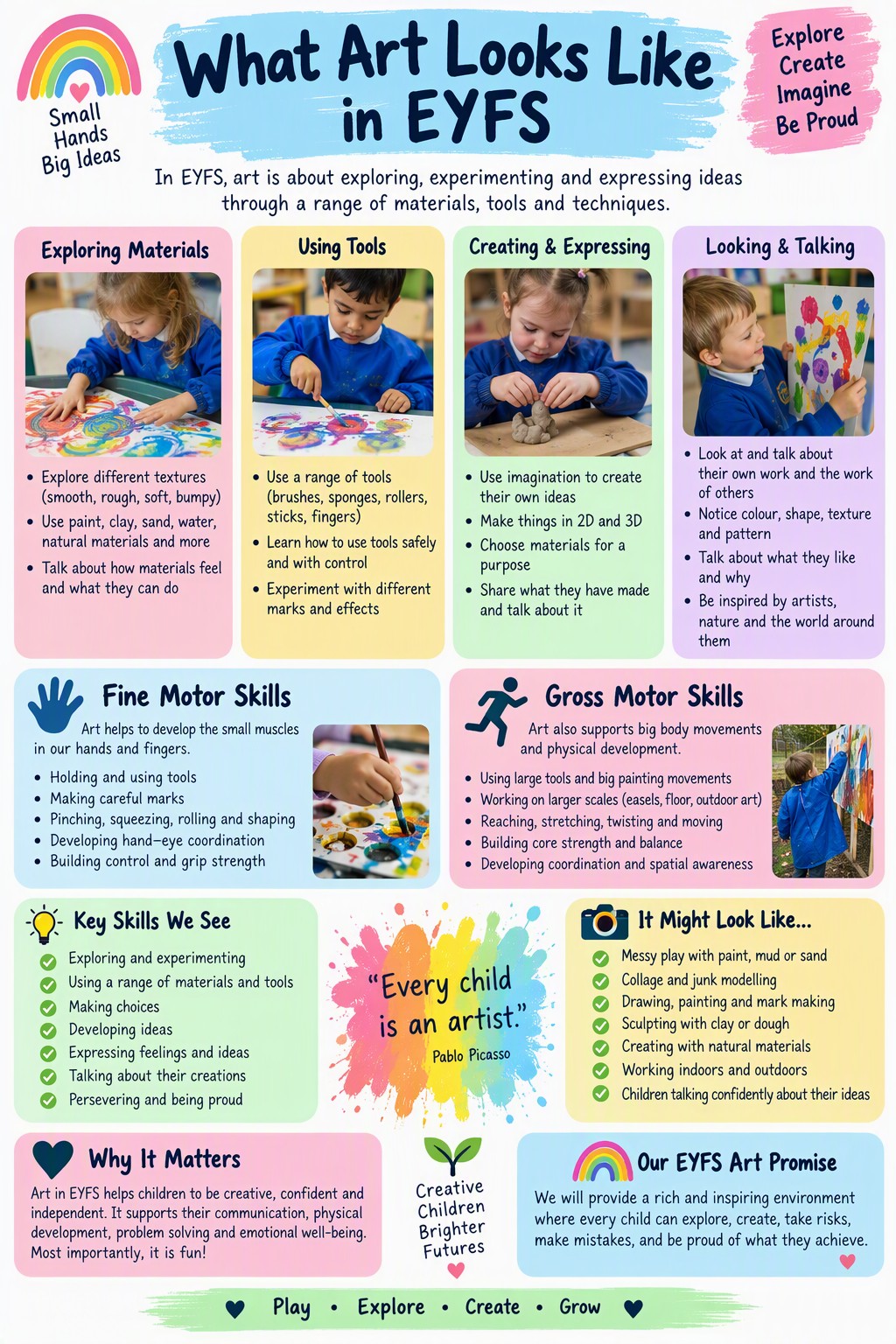
Our Art Curriculum
Artistic Opportunities within the local community:
-
Millennium Gallery in Sheffield: https://www.museums-sheffield.org.uk/museums/millennium-gallery/home
- Graves Gallery in Sheffield:
Graves Gallery in Sheffield: https://www.museums-sheffield.org.uk/museums/graves-gallery/home
-
Sculptures at Chatsworth House: https://www.chatsworth.org/visit-chatsworth/chatsworth-estate/art-archives/devonshire-collections/sculpture/
-
Yorkshire Sculpture Park: https://ysp.org.uk/visit
-
The Painted Teapot Dronfield: https://www.dayoutwiththekids.co.uk/attractions/the-painted-teapot-8120a548